skip to main |
skip to sidebar
The San Francisco International Film Festival (SFIFF) heads crosstown to the Mission District for its 59th edition, thereby concluding nearly three decades of being headquartered at Japantown's Sundance Kabuki Cinemas. Robert Redford's independent movie chain was sold last autumn to Carmike Cinemas, who in turn sold it to AMC Theatres last month. All of this fortuitously coincided with the December opening of Alamo Drafthouse's New Mission Theatre following a two-year, $10 million restoration and retrofit. The gloriously reborn Mission Street movie palace will serve as the ornate nexus of SFIFF59, running from April 21 to May 5.
A movie theatre of some sort or other has existed since 1911 in the spot where Alamo Drafthouse Cinema stands today. Additional SFIFF59 venues, all relatively nearby and also hailing from the early 20th century include the Roxie Theater (1909), Victoria Theatre (1907) and of course the Castro Theatre (1922). The former Grand Theatre (1940) just down the block from New Mission is now a non-profit called Gray Area ("Supporting Art & Technology for Social Good") and will be utilized for select non-screening events. Festival-goers also have the option of taking in the spanking new Pacific Film Archive in Berkeley. All venues but the Castro are located within two blocks of a BART subway station.

Last month I cocooned in the New Mission for 12 continuous hours, watching five back-to-back programs at the SF Jewish Film Festival's Winterfest event. It's truly astounding how they've transformed this former dilapidated futon store, which is what the building became once movies stopped being shown in 1993. It will be interesting to see how festival audiences respond to Alamo Drafthouse's modus operandi of selling seat-side food and cocktails. My own reaction was mixed. Yes, it was occasionally distracting having servers slip in and out making deliveries in the auditorium. On the other hand, I loved being able to suck down a Singapore Sling and nosh on a lamb meatball pizza without having to get off my butt and go get them.
I've faithfully attended SFIFF every year since 1976 and this will be my 10th year covering it as accredited press. Last year's edition was majorly epic – six of my Top Ten Films of 2015 had their Bay Area premieres at the festival. This year is looking pretty impressive as well. Here's an overview of what's been announced thus far, followed by a wish list of 15 films I'm hoping will be part of the full line-up when its announced at tomorrow morning's press conference.
Opening Night
The festival opens on Thursday, April 21 with Whit Stillman's Love & Friendship. The perpetually preppie director's Damsels in Distress is probably my favorite comedy of the past 10 years and I'm thrilled he's expected to attend the Castro Theatre screening along with star Kate Beckinsale. The film is based on Jane Austen's posthumously published early novel "Lady Susan" and reunites Beckinsale with Chloë Sevigny, her co-star in Stillman's 1998 The Last Days of Disco. Critics at Sundance declared Austen and Stillman's sensibilities a perfect match, while heaping special praise upon Beckinsale's performance as ruthless, social-climbing Lady Susan. After the program, SFIFF59's opening night party takes place at Mission District event space Public Works, located a not-too-strenuous stroll from the Castro.
Closing Night
In keeping with a tradition of closing the fest with something offbeat, SFIFF59 concludes at the Castro 15 days later with The Bandit. Fresh off its SXSW world premiere, the latest from Bay Area documentarian Jesse Moss celebrates the close friendship between actor Burt Reynolds and his Smokey and the Bandit director, legendary Hollywood stuntman Hal Needham. Smokey, for those too young to remember, was the second highest grossing film of 1977 after Star Wars. If director Moss' name sounds familiar, it's because he won the festival's Best Documentary award two years ago with The Overnighters, a controversial portrait of a North Dakota fracking boomtown. The closing night party will be at the Mezzanine in downtown San Francisco.
Centerpiece Film
The movie chosen for this year's Centerpiece slot is Indignation, based on Phillip Roth's 2008 semi-autobiographical novel about a Jewish student from NJ attending college in 1951 Ohio. It reps the directorial debut of James Schamus, the writer/producer and Focus Features CEO perhaps best known for penning the majority of Ang Lee's films. Schamus last attended SFIFF in 2010, when he was presented with the Kanbar Award for Screenwriting. Indignation stars Logan Lerman (The Perks of Being a Wallflower) and garnered stellar reviews at both Sundance and Berlin. Roth himself has called it the most truthful adaptation of his work to date. The Centerpiece presentation will take place at the Victoria Theatre on Saturday, April 30.
Vampyr with Mercury Rev
The festival brings back its annual pairing of silent cinema with contemporary music when alt-rock iconoclasts Mercury Rev world-premiere their new score for Carl Theodor Dreyer's 1932 horror classic, Vampyr. To be honest, I haven't thought about Mercury Rev since their 1991 debut album "Yerself is Steam," but research shows me they've had a long career, winning NME's Best Album of 1998 and releasing a new album just last year. Joining current Rev members Jonathan Donahue and Sean Mackowiak will be Simon Raymonde, the ethereal-sounding multi-instrumentalist who comprised one-third of classic-era Cocteau Twins, as well as Jesse Chandler of Midlake and Michael Jerome Moore from Better Than Ezra. Vampyr was Dreyer's follow-up to his venerated The Passion of Joan of Arc and while not technically a silent film, its story is largely told through visuals and intertitles. This special performance takes place at the Castro Theatre on Monday, May 2.
Mel Novikoff Award
Who could possibly be more deserving than Janus Films and Criterion Collection to receive this award, given to an "individual or institution whose work has enhanced the filmgoing public's knowledge and appreciation of world cinema." At a Castro Theatre presentation on Saturday, April 30, current Janus/Criterion partners Peter Becker and Jonathan Turell will be on hand for an on-stage conversation, followed by a screening of their most recent restoration, Joel and Ethan Coen's 1984 breakout, Blood Simple. The Coens themselves are expected to attend the program and participate in the on-stage discussion with Variety critic Scott Foundas. Bay Area exhibitor Novikoff was an avid champion of the brothers' debut film. They honored him nearly 30 years later by naming an Inside Llewyn Davis supporting character "Mel Novikoff."
Persistence of Vision Award
Since its inception in 1997, the festival's Persistence of Vision Award has honored the "achievement of a filmmaker or institution whose main body of work is outside the realm of narrative feature filmmaking." This year's honoree is none other than four-time Oscar® winner Aardman Animations, the beloved British studio responsible for Wallace & Gromit, Chicken Run, Shaun the Sheep and Peter Gabriel's groundbreaking "Sledgehammer" music video. To help celebrate Aardman's 40th anniversary at a Castro Theatre program on Sunday, May 1, co-founder and creative director Peter Lord will participate in an on-stage discussion and preside over a screening of Aardman shorts.
Golden Gate Awards New Directors Prize
Nine narrative features will compete for this year's New Directors Prize. I saw both Yaelle Kayam's Mountain and Lorenzo Vigas' From Afar at the Palm Springs International Film Festival back in January. Both are compelling enough to warrant second viewings and both feature provocative endings that could render them the most talked about films at SFFF59. Mountain is the story of a Jewish Orthodox housewife in Jerusalem whose life changes when she discovers the nearby cemetery doubles as a nocturnal hangout for prostitutes and drug addicts. From Afar won the top prize (Golden Lion) at last year's Venice Film Festival and stars esteemed Chilean actor Alfredo Castro (Tony Manero, The Club) as a closeted gay man who enters into a volatile relationship with a young street tough.
Amongst the remaining seven entries, I'm most excited about Clément Cogitore's Neither Heaven Nor Earth, which premiered in Cannes' Critics Week sidebar and has thus far screened at festivals under the title The Wakhan Front. In this elevated genre piece, French star Jérémie Renier plays an Afghanistan army captain whose men are disappearing under possibly supernatural circumstances. I've also heard terrific things about Leyla Bouzid's As I Open My Eyes, which places the struggles of a free-spirited young woman within the context of Tunisia's 2010 Arab Spring revolution. Remaining New Directors Prize contenders include films from Canada (The Demons), Bulgaria (Thirst), India (Thithi), Lebanon (Very Big Shot) and Czech Republic (Home Care, which was also that country's 2015 Oscar® summission).
Golden Gate Awards Documentary Feature Competition
Of the 11 films competing for SFIFF59's top doc prize, the only one to previously cross my radar is Kirsten Johnson's autobiographical Cameraperson, which collected rave reviews at festivals like Sundance, True/False, New Directors New Films and SXSW. Johnson is a celebrated non-fiction cinematographer best known for her collaborations with directors Laura Poitras (Citizen Four, The Oath) and Kirby Dick (The Invisible War, This Film is Not Yet Rated).
Elsewhere in the competition I have high hopes for Moby Longinotto's The Joneses. The director is the son of 2015 Persistence of Vision Award winner Kim Longinotto and he got his start as assistance editor on mum's 1998 documentary Divorce Iranian Style. The Joneses won the SF Film Society's 2014 Documentary Film Fund Grant and concerns a family of Mississippi trailer park denizens and their 73-year-old transgender matriarch. Another doc I don't want to miss is Katie Galloway and Kelly Duane de la Vega's The Return. The directors won this competition in 2011 with their powerful film Better This World and their latest shadows the fate of several inmates following the loosening of California's Three Strikes law. Other challengers for the doc prize include looks at a remote Bolivian salt flat (Salero), life in North Korea (Under the Sun) and a portrait of Dr. John Romulus Brinkley, an early 20th century radio mogul, politician and champion of goat testicle impotence cures (NUTS!, directed by Our Nixon's Penny Lane).
* * * * * *
Every year I can't help but ruminate on which films might get chosen for festival inclusion. Some distinct possibilities can be found on Landmark Theatres upcoming release calendar, such as Aleksandr Sokurov's Francofonia (April 29), Ben Wheatley's High Rise (May 13), Rebecca Miller's Maggie's Plan (May 27) and Athina Rachel Tsangari's Chevalier (June 10). Amongst the movies I caught at Palm Springs this year, I'd say Alex van Warmerdam's Schneider vs. Bax, Gabriel Mascaro's Neon Bull (opening at the Roxie on May 6), Santiago Mitre's Paulina and Jerzy Skolimowski's 11 Minutes would all be worthy selections. And while many high profile titles from Sundance and Berlin don't show up in the Bay Area until later, you won't hear me complain if we're fortunate enough to see Mia Hansen Løve's Things to Come, André Téchiné's Being 17, Kelly Reichhardt's Certain Women, Ira Sach's Little Men, Kiyoshi Kurosawa's Creepy, Danis Tanovic's Death in Sarajevo or Todd Solondz' Weiner-Dog.
The following are 15 titles I'm fervently hoping to find on the SFIFF59 roster. All played the festival circuit in 2015 and all but one have yet to screen in the Bay Area.
The Academy of Muses (Spain, dir. José Luis Guerín)
The director of the 2008's enchanting and enigmatic In the City of Sylvia returns with a second singularly-styled narrative feature, this one centered around a libidinous professor and his female students.
Afternoon (Taiwan, dir. Tsai Ming-liang)
In this experimental documentary, the world's foremost maestro of slow-cinema converses with Lee Kang-sheng, the gay director's straight acteur fétiche, muse, housemate and star of his eleven feature films.
The Apostate (Spain, dir. Fernando Veiroj)
Uruguayan filmmaker Veiroj, whose melancholy B&W ode to a soon-to-be unemployed Montevideo cinematheque manager (A Useful Life) played SFIFF five years ago, follows up with this existential satire about a Spanish man attempting to leave Catholicism.
Arabian Nights, Volumes 1, 2, & 3 (Portugal, dir. Miguel Gomes)
With last year's passing of Manoel de Oliveira at age 108, the mantle of being Portugal's most important living filmmaker passes onto Gomes (Tabu, Our Beloved Month of August). These three interrelated films adapt the traditional structure of "Arabian Nights" in order to ponder the misbegotten backwash of Portuguese economic austerity. Although readily available on multiple VOD platforms, my fingers are crossed for a big screen experience.
Cosmos (France, dir. Andrzej Zulawski)
One of the world's great transgressive filmmakers, probably best known for his 1981 Isabelle Adjani-starring shocker Possession, won Locarno's Best Director prize for what has turned out to be his swan song (Zulawski passed away on February 17).
Evolution (France, dir. Lucile Hadzihalilovic)
This long-awaited follow-up to Innocence, the unsettling 2004 debut from Gaspar Noé's wife and sometime collaborator, was supposed to open locally on May 27. That's been cancelled due to the collapse of distributor Alchemy Films (see The Lobster below). It was snapped up by IFC Midnight for eventual VOD release, but I want to see it now.
Fatima (France, dir. Philippe Faucon)
The latest from SFIFF alum Faucon (Samia, The Betrayal, Two Ladies) was the surprise winner at this year's César Awards, taking home prizes for Best Picture, Adapted Screenplay and Promising Actress. The 78-minute dramedy concerns a Moroccan-born mother raising two teen daughters in Lyon.
Helmut Berger, Actor (Austria, dir. Andreas Horvath)
This documentary about the iconic European actor was ranked #1 on John Waters' Artforum Best of 2015 list, with a disclaimer from Waters qualifying it as the worst film of 2015 as well. Call me intrigued.
Land and Shade (Colombia, dir. César Acevedo)
The Camera d'Or prize for best first feature film at Cannes went to this austere, atmospheric portrait of a struggling sugarcane farming family.
The Lobster (Ireland/UK/Greece, dir. Yorgos Lanthimos)
Due to troubles with U.S. distributor Alchemy Films, this Cannes Jury Prize winner from Greek dystopian misanthrope Lanthimos (Dogtooth) has had its Bay Area theatrical release delayed numerous times. Can we please just see it already? I'm hoping exposure at a small North Bay festival last year won't disqualify it for SFIFF inclusion.
Men & Chicken (Denmark, dir. Anders Thomas Jensen)
Denmark's best known screenwriter (In a Better World, After the Wedding) finally follows up his brilliant 2005 satire Adam's Apples with this black comedy about two outcast brothers. It's being released in the U.S. by none other than Drafthouse Films, the film distribution arm of SFIFF59's principal venue, Alamo Drafthouse.
Right Now, Wrong Then (South Korea, dir. Hong Sang-soo)
Hong is arguably Asia's most prolific arthouse filmmaker and SFIFF has done its best to keep up with his massive output, screening a Hong joint in four of the past five years. His latest won the top prize (Golden Leopard) at last year's Locarno Film Festival.
Standing Tall (France, dir. Emmanuelle Bercot)
Bercot's slice of social realist cinema concerns a delinquent navigating France's juvenile justice system and was considered an unlikely opener for Cannes. The intriguing cast includes Catherine Deneuve, Sara Forestier and César supporting actor winner Benoît Magimel.
The Story of Judas (France, dir. Rabah Ameur-Zaïmeche)
This Algerian-born actor/director follows up Smuggler's Songs, which played the fest four years ago, with a new work that reimagines Judas Iscariot (played by the director) as the most dedicated of Jesus' disciples.
Two Friends (France, dir. Louis Garrel)
France's most impossibly handsome young actor follows in the footsteps of his director father with this debut feature about a ménage à trois among unlikely friends. Garrel stars, with Vincent Macaigne and Iranian superstar Golshifteh Farahani completing the triangle.
Cross-published at The Evening Class.
Top Ten Favorite Narrative Features
Love & Mercy (USA dir. Bill Pohlad)
The biopic genre got a needed kick in the pants with this transcendent portrait of troubled Beach Boys genius Brian Wilson, brilliantly realized by actors Paul Dano and John Cusack. Screenwriter Oren Moverman (Todd Haynes' I'm Not There) alternates emotionally interlocking vignettes of Wilson during two contrasting eras – the creative peak of masterminding "Pet Sounds" and "Smile" and his early 90's nadir under the dictatorial control of evil psychiatrist Eugene Landy. The movie's real revelation, however, is Elizabeth Banks' wrenching performance as Melinda Ledbetter, the Cadillac saleswoman who selflessly comes to Wilson's emotional rescue
Tangerine (USA dir. Sean Baker)
Move over It's a Wonderful Life, there's a new holiday classic in town – one in which a pair of transgender hookers drag the audience on a Xmas Eve cross-town rampage in search of an unfaithful pimp boyfriend. Bursting with propulsive energy and featuring gloriously garish, candy-colored cinematography (famously shot on a tricked-out iPhone 5s), Baker's screwball comedy for the 21st century hurls us through a Los Angeles netherworld of strip malls, crack dens and drive-thru carwash blowjobs. The rough edges get smoothed over by a pair of endearing and unforgettable performances by Kitana Kiki Rodriguez and Mya Taylor.
Li'l Quinquin (France dir. Bruno Dumont)
With this four-part TV mini-series, formalist auteur Dumont made his best film since The Life of Jesus, his 1997 debut. Set in a coastal village where human corpses are being stuffed inside dead cows, this policier-of-sorts has the touchstones of Dumont's earlier work – off-kilter non-pro actors, wide-screen vistas and impassioned examinations of morality, violence, racism and religion. What sets Li'l Quinquin apart is its uncommon hilarity (the non-intentional humor of Humanité and Twentynine Palms notwithstanding). While I'm glad to have caught this on a big screen at last year's Palm Springs International Film Festival, it's effective on smaller formats as well.
The Forbidden Room (Canada dir. Guy Maddin & Evan Johnson)
While I'm certain that nostalgia-obsessed absurdist Guy Maddin has many more films in him, it's not too early to cast magnum opus status upon this fevered, overstuffed paean to the lost films of cinema's early sound era. The movie begins with a droll demonstration on "How to Take a Bath" that segues into a cockeyed lost submarine adventure. By The Forbidden Room's end we've lurched along a preposterous plotline boasting bladder-slapping contests, virgin volcano sacrifice and poisoned leotards. It was a special thrill catching this at the SF International Film Festival with Maddin indulging his fans in a generous Q&A that lasted into the early morning hours.
Aferim! (Romania dir. Radu Jude)
Radu Jude won the Best Director's Prize at Berlin for this neo-Western cum road movie about a constable returning an escaped Roma slave to his malevolent boyar overseer. Stunning B&W widescreen cinematography, a gallery of finely drawn characters and spot-on period art direction all contribute towards making this sweeping epic a captivating examination of another era's mores and customs. It's also an eye-opening portrayal of slavery and anti-Jewish/Roma sentiment in 19th century Eastern Europe that has plenty of resonance for today.
The Overnight (USA dir. Patrice Brice)
This 79-minute Duplass Brothers-produced indie – reportedly made for under $200K – was the funniest and sexiest movie I saw in 2015. It's also a pointed social satire that's loaded with surprises and much heartfelt charm. Jason Schwartzman plays one-half of an ebullient L.A. nouveau riche couple who invite non-descript Seattle transplants Adam Scott (Parks and Recreation) and Taylor Schilling (Orange is the New Black) over for a Friday night playdate after their young sons bond in the park. Sphincter paintings, breast pump infomercials and anxiety over penis size all enter into the merriment once the kids get put to bed. I loved it even more on second viewing.
Alléluia (Belgium/France dir. Fabrice du Welz)
The sordid saga of American "Honeymoon Killers" Raymond Fernandez and Martha Beck got a French twist in this ultra-perverse remake starring Laurent Lucas (the prey in Du Welz' 2004 psychotic hillbilly shocker Calvaire). Lola Dueñas (Volver, The Sea Inside) co-stars as the victim turned co-conspirator whose sexual jealousy summons forth a grisly body count. Alléluia oozes style, with grainy 16mm complementing the film's 70s exploitation vibe, and claustrophobic hand-held close-ups seemingly emulating fellow Belgian auteurs Jean-Pierre and Luc Dardenne. The scene in which Dueñas sings an ill-omened aria over a naked corpse splayed across a kitchen table – before cutting off its foot with a hacksaw – was for better or worse the most hauntingly beautiful thing I saw at the movies in 2015.
The New Girlfriend (France, dir. François Ozon)
The latest from France's most entertainingly subversive director slapped a grin on my face during its bravado opening sequence, refusing to let go until long after the credits had rolled. In one of his finest performances to date, French superstar Romain Duris plays a widower who dresses in his recently deceased wife's clothes as a way of comforting their infant daughter. When his wife's BFF (Anaïs Demoustier) catches him in the act, the pair embark on a surprise-filled adventure encompassing gender fluidity, confused sexual desire and plenty of red-herring dream sequences. This witty, tightly-wound transgender dramedy is based on a Ruth Rendell novel, whose works were also the source material for Chabrol's La Cérémonie and Almodóvar's Live Flesh.
The Tribe (Ukraine, dir. Myroslav Slaboshpytskiy)
Set in a Ukrainian school for the hearing impaired, the entirety of The Tribe's dialogue is "spoken" in unsubtitled sign language, requiring the viewer to pay strict attention to the actors and on-screen action. That's an easy task given the riveting storyline and meticulously choreographed, widescreen cinematography. The plot shadows a new pupil who becomes a participant in the nihilistic schemes of his bullying classmates, which includes the transport of female students to a local truck stop for prostitution. An unbearably frank abortion scene serves as a litmus test for one's ability to withstand cinematic transgression, and had the SF International Film Festival audience fleeing for the exits. Detractors have labeled the The Tribe exploitative and soulless. For me it represents filmmaking at its most dynamic and singular.
The Hateful Eight: 70mm Roadshow Engagement (USA dir. Quentin Tarantino)
While I absolutely loved this deliriously mean-spirited chamber drama, I'll admit it was the pimped-out roadshow extras – jaw-droppingly gorgeous 70mm (yes, I'm talking about the interiors as well as the exteriors), overture, intermission and 14-page souvenir booklet – that ultimately goosed this into my 2015 Top Ten.
Bubbling Under the Top Ten
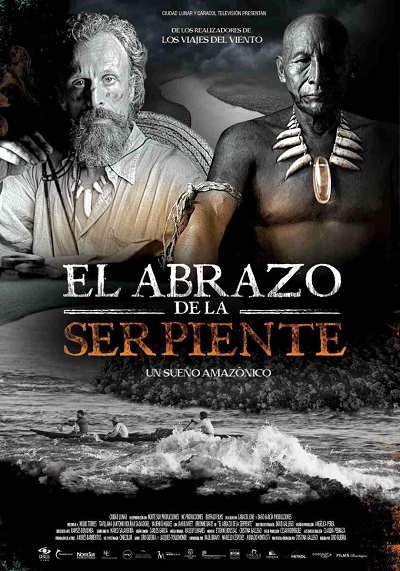
Embrace of the Serpent (Colombia, dir. Ciro Guerra)
Gett: The Trial of Viviane Amsalem (Israel, dir. Ronit & Shlomi Elkabetz)
Goodnight Mommy (Austria, dir. Severin Fiala & Veronika Franz)
Hard to be a God (Russia, dir. Aleksey German)
Mad Max: Fury Road (Australia/USA, dir. George Miller)
The Best of the Rest
Amour Fou (Austria, dir. Jessica Hausner)
The Assassin (Taiwan, dir. Hou Hsiou-hsien)
Black Coal, Thin Ice (China, dir. Diao Yi'nan)
Bridge of Spies (USA, dir. Steven Spielberg)
Carol (USA, dir. Todd Haynes)
Corn Island (Georgia, dir. George Ovashvili)
Court (India, dir. Chaitanya Tamhane)
Dheepan (France, dir. Jacques Audiard)
Diplomacy (France/Germany, dir. Volker Schlöndorff)
Disorder (France, dir. Alice Winocour)
Eden (France, dir. Mia Hansen-Løve)
The End of the Tour (USA, dir. James Ponsoldt)
Experimenter (USA, dir. Michael Almereyda)
A Few Cubic Meters of Love (Afghanistan, dir. Jamshid Mahmoudi)
Fidelio, Alice's Journey (France, dir. Lucie Borleteau)
The Gift (Australia/USA, dir. Joel Edgerton)
Güeros (Mexico, dir. Alonso Ruizpalacios)
Hill of Freedom (South Korea, dir. Hong Sang-soo)
Hungry Hearts (Italy, dir. Saverio Costanzo)
In the Grayscale (Chile, dir. Claudio Marcone)
The Measure of a Man (France, dir. Stéphane Brizé)
Mistress America (USA, dir. Noah Baumbach)
Nasty Baby (USA, dir. Sebastián Silva)
The Perfect Dictatorship (Mexico, dir. Luis Estrada)
Phoenix (Germany, dir. Christian Petzold)
Red Amnesia (China, dir. Wang Xiaoshuai)
Room (USA, dir. Lenny Abrahamson)
Saint Laurent (France, dir. Bertrand Bonello)
La Sapienza (France/Italy, dir. Eugène Green)
Seashore (Brazil, dir. Filipe Matzembacher & Marcio Reolon)
Son of Saul (Hungary, dir. László Nemes)
Steve Jobs (USA, dir. Danny Boyle)
Tangerines (Estonia/Georgia, dir. Zaza Urushadze)
Two Days, One Night (Belgium, dir. Jean-Pierre & Luc Dardenne)
Valley of Love (France, dir. Guillaume Nicloux)
Victoria (Germany, dir. Sebastian Schipper)
Welcome to New York (USA, dir. Abel Ferrara)
What We Do in the Shadows (New Zealand, dir. Jemaine Clement & Taika Waititi)
Winter Sleep (Turkey, dir. Nuri Bilge Ceylan)
Top Ten Favorite Documentary Features
Maidan (Ukraine, dir. Sergei Loznitsa)
Winter on Fire (Ukraine/UK, dir. Evgeny Afineevsky)
Call Me Lucky (USA, dir. Bobcat Goldthwait)
The Pearl Button (France/Chile, dir. Patricio Guzmán)
Best of Enemies (USA, dir. Robert Gordon & Morgan Neville)
All of Me (Mexico, dir. Arturo González Villaseñor)
Amy (UK/USA, dir. Asif Kapadia)
Listen to Me Marlon (UK, dir. Stevan Riley)
The Wanted 18 (Occupied Palestinian Territory, dir. Paul Cowan & Amer Shomali)
Hitchcock/Truffaut (France/USA, dir. Kent Jones)
The Best of the Rest
Arteholic (Germany, dir. Hermann Vaske)
Cartel Land (Mexico/USA, dir. Matthew Heineman)
Cobain: Montage of Heck (USA, dir. Brett Morgen)
Do I Sound Gay? (USA, dir. David Thorpe)
Drunk Stoned Brilliant Dead: The Story of National Lampoon (USA, dir. Douglas Tirola)
Going Clear: Scientology and the Prison of Belief (USA, dir. Alex Gibney)
The Look of Silence (Denmark, dir. Joshua Oppenheimer)
Tab Hunter Confidential (USA, dir. Jeffrey Schwarz)
What Happened, Miss Simone? (USA, dir. Liz Garbus)
The Wolfpack (USA, dir. Crystal Moselle)
The San Francisco Silent Film Festival (SFSFF) takes command of the Castro Theatre this Saturday for A Day of Silents, a one-day, all-day autumn adjunct to the festival's main event held each spring. Highlights include an entire feature in two-strip Technicolor (The Black Pirate with Douglas Fairbanks), the resurrection of a long lost Harry Houdini film (The Grim Game) and a new restoration of Marcel L'Herbier's marvel of modernism, L'Inhumaine. Attendees will also travel Around China with a Movie Camera and experience a landmark silent starring Anna May Wong (Piccadilly). All five programs are being presented for the first time in the festival's 20-year history.
11:00 AM
The Black Pirate (1926 US dir. Albert Parker)

The day kicks off with the world's earliest, fully extant feature film shot entirely in two-strip Technicolor. Douglas Fairbanks, then at the height of his popularity, stars as a nobleman who avenges his father's death by surreptitiously joining a band of pirates. The film contains one of the actor's most famous stunts, whereby he slides down a ship's massive sail while simultaneously slicing it in half. The Black Pirate is also noted for its early underwater photography shot in and around Santa Catalina island. "The First King of Hollywood: The Life of Douglas Fairbanks" is a new book written by SFSFF board member Tracey Goessel, and she'll be on hand to introduce the movie. Musical accompaniment will be provided by the singular Alloy Orchestra, who celebrate their silver anniversary this year. Alloy has been largely missing from the festival proper in recent years, so it's terrific having them appear at these mid-year special events (they accompanied The Son of the Sheik and The General at 2014's Silent Autumn).
1:00 PM
Around China with a Movie Camera (1900 - 1948 China)
From the British Film Institute comes this compilation of travelogues, newsreels and amateur footage shot in China during the first half of the 20th century. They were made by a diverse group of French and British filmmakers that included missionaries, tourists, colonial-era ex-pats and a few bona fide professionals. High points include footage of turn-of-the-century Shanghai, 1910 imperial Beijing, the canals of Hangzhou in 1925 and scenes of various Hunan villages. Around China with a Movie Camera had its world premiere at this past June's Shanghai International Film Festival. It will be accompanied here in San Francisco by the inimitable Donald Sosin.
3:00 PM
The Grim Game (1919 US dir. Irvin Willat)
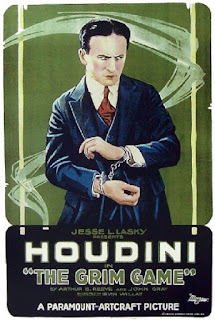
Magician and escape artist Harry Houdini was 45-years-old when he made this, his first feature. It was regarded as a lost work until just recently, when restorer Rick Schmidlin coaxed a copy from the hands of a 95-year-old retired Brooklyn magician/juggler named Larry Weeks. With Turner Classic Movies footing the bill, Schmidlin brought The Grim Game back to life and the restoration had its world premiere closing out this year's TCM Classic Film Festival. The plot is enough to make one's head spin, so let it suffice to say that Houdini plays a reporter who frames himself for murder in order to prove a point about circumstantial evidence. Feats of derring-do abound, including a jail break, extrication from a bear trap and an escape from a straightjacket while dangling off a tall building. The climax is an un-scripted midair plane collision from which Houdini escaped unharmed, not in small part because he was nowhere near the scene (although for years he claimed otherwise). The SFSFF presentation of The Grim Game will be introduced by the film's restorer Rick Schmidlin and Donald Sosin will accompany.
6:30 PM
L'Inhumaine (The Inhuman Woman) (1924 France dir Marcel L'Herbier)

This melodrama with fantastical elements was described by its director/creator as "a fairy story of modern decorative art." It was also a financial disaster whose exhibition provoked fistfights between adherents and opponents. The plot loosely hangs on the story of an icy opera singer and the cadre of admirers she abuses. The titular inhuman woman is played by real-life singer Georgette Leblanc, a friend of the director who also put up half the financing. The real stars, however, are the eye-popping sets and costumes that sprung from the imaginations of painter Fernand Léger, architect Robert Mallet-Stevens and others. Pablo Picasso, Man Ray, Erik Satie, James Joyce and Ezra Pound all appear as extras in the movie's famous concert hall scene. Serge Bromberg's Lobster Films recently completed a restoration of L'Inhumaine, commissioning the Alloy Orchestra to compose a new score which they'll perform live on Saturday evening. Those who saw L'Herbier's L'Argent at SFSFF's Winter Event in 2011 have every reason to expect something wondrous.
9:15 PM
Piccadilly (1929 UK dir E.A. Dupont)

Anna May Wong left Hollywood for Europe in the late 1920's, searching for the kind of substantive roles that eluded the Chinese-American actress in Tinseltown. Piccadilly was the second of her British films and is generally regarded as the peak of her silent era career. In this lurid melodrama/proto-noir, Wong ascends from nightclub dishwasher to star attraction, thereby triggering a scenario of jealousy, betrayal and murder. In addition to fluid camerawork and hints of expressionism, the film is notable as the feature debut of Charles Laughton, who appears briefly as a boorish customer. Piccadilly last screened in San Francisco as part of a four-film Anna May Wong retrospective at the 2004 SF International Asian American Film Festival (now CAAMFest). This will be the only 35mm presentation at A Day of Silents, and the inside word has it that the tinted and toned print from Milestone Films is as "dazzling as the day the British Film Institute restored it." Donald Sosin accompanies, with an assist from Bay Area percussionist John Mader.
The San Francisco Film Society (SFFS) concludes its ambitious 2015 Fall Season this weekend with French Cinema Now (FCN), a four-day, 11-film mini-fest whose line-up ranges from Cannes champions to under-the-radar indies to an animated box office behemoth. The festival's eighth edition is also notable for the fact that nearly half its entries were directed by women. Here's a subjective primer on the promising choices available to local Franco-cinephiles this Thursday through Sunday at San Francisco's historic Vogue Theatre.

If I could only partake in one day of FCN2015, I'd choose Sunday's quadruple bill that begins with Guillaume Nicloux' Valley of Love. This Cannes competition contender boasts Isabelle Huppert and Gérard Depardieu, co-starring for the first time since Maurice Pialat's Loulou in 1980 (the year Huppert also appeared in Heaven's Gate). The iconic duo plays ex-spouses on a pilgrimage to Death Valley at the behest of a son who committed suicide. Their characters are famous French actors named Isabelle and Gérard and said son has promised to "appear" if they follow explicit instructions he left in a letter. Reviews for Valley of Love were decidedly mixed, with critics uneasy about the film's – as Variety's Guy Lodge put it – "muddling of the metaphysical with the just plain meta." Critics did agree that the immense charms of watching Huppert and Depardieu's reunification, coupled with the spectacular Death Valley scenery trumped most misgivings over the movie's specious spirituality. Depardieu's performance was particularly singled out for accolades. After this year's impressive turn in Abel Ferrara's Welcome to New York, perhaps it's time to once again take this guy seriously and blot out the bloated lout we've observed pissing in planes and pandering to Putin.
I have two other reasons for highly anticipating Valley of Love – Death Valley is my third favorite place on the planet, and I recently had the chance to watch director Nicloux's two previous features. Both were compelling for different reasons and now I'm very curious to see what he's done next. Unfortunately, neither The Nun (in which Huppert has a supporting role as a horny Mother Superior) or The Kidnapping of Michel Houellebecq, a comically fabricated documentary about France's gadfly writer/intellectual, have ever screened in the Bay Area. Fortunately both are available on Netflix streaming, however, providing ample ammunition against the whiners who claim Netflix' library is all crap.

Sunday's FCN roster continues on a meta tip with Léa Fazer's Maestro, which riffs on the production of the final film by French auteur Eric Rohmer (here renamed Cédric Rovère). The script is based on the experiences of Jocelyn Quivrin, an immature and struggling young actor who struck up a mutually edifying friendship with 86-year-old Rohmer during the filming of 2007's pastoral costume drama, The Romance of Astrea and Celadon. (Quivrin died in a 2009 car accident at age 30, followed by Rohmer the following year). Quivrin's character is played by Pio Marmaï, who has become one of my favorite French actors and is certainly no stranger to SFFS audiences. I first took note of him five years ago as the sexy drug trafficker in Living on Love Alone (SFIFF2011), followed by acclaimed appearances in Aliyah, Nights with Theodore (SFIFF2013 FIPRESCI prize-winner) and last year's FCN opening nighter Paris Follies (playing Isabelle Huppert's side dish). Resurrecting the memory of Rohmer/Rovère is venerable veteran Michel Lonsdale, with another personal favorite, Déborah François (The Child, The Page Turner, Populaire) in a supporting role as Quivrin's imagined co-actor/love interest.

Situated in Sunday's third timeslot is the FCN movie I'm most dying to see, Stéphane Brizé's The Measure of a Man. It won the best actor prize at Cannes for Vincent Lindon in a performance Variety's Scott Foundas called "a veritable master class in understated humanism." Like Pio Marmaï, Lindon has been a fixture for FCN audiences in films such as The Moon Child and Welcome. Here in the U.S. he's best recognized as the married building contractor who falls for his son's homeroom teacher in Mademoiselle Chambon, a work that was also directed by Brizé (and which played for several months at Landmark's Clay Theatre back in 2010). In this outing with the director, who also co-wrote the screenplay, Lindon portrays a laid-off factory worker struggling to support his family before finally finding work as a big-box store security guard. That new job, however, proves an unending source of personal moral conflict. Shot in long, unbroken takes with a mostly non-professional cast, I'm expecting The Measure of a Man to be the kind of heart-wrenching social drama that seems the exclusive provenance of humanist French-language filmmakers like the Dardenne Brothers and Robert Guédiguian.

FCN closes on Sunday evening with In the Shadow of Women, yet another messy male/female relationship drama from post-New Wave auteur Philippe Garrel. While I'm not exactly a fan – for me the director's greatest achievement was spawning his impossibly handsome son and sometime collaborator, actor Louis Garrel – I'll jump at any opportunity to catch his films on the big screen. Garrel's protagonist this time out is a documentary filmmaker (played by Stanislas Merhar, the Almayer of Chantal Akerman's Almayer's Folly) whose wife is also his film editor. Over the course of the movie they'll both enter into extra-marital affairs, rendering In the Shadow of Women a pointed examination of the double standard applied to women when it comes to infidelity. The film opened the Director's Fortnight sidebar at this year's Cannes and was well received by critics. Some detected more humor than is usual for a Garrel joint, and others remarked that his debut collaboration with legendary screenwriter Jean-Claude Carrière resulted in a more cohesive and focused storyline. What hasn't changed is the impressive B&W widescreen cinematography and participation of son Louis, who provide off-camera voiceover narration. In the Shadow of Women clocks in at a brisk 73 minutes, making it the perfect film with which to end an exhaustive day of festival-going.

FCN2015 gets started four nights earlier with Arnaud Desplechin's My Golden Days, a prequel to his 1996 film My Sex Life…or How I Got Into an Argument. The movie premiered in Cannes' Director's Fortnight to solid raves, with Variety's Justin Chang calling it "some of the most fluid, emotionally resonant filmmaking of Desplechin's career." A handful of critics even decried the fact that it hadn't screened in the fest's main competition, unlike his two previous works, 2013's wrongly maligned Jimmy P with Benicio Del Toro (never screened in the Bay Area but available on Netflix streaming) and my personal Desplechin favorite, 2008's A Christmas Tale. My Golden Days takes the characters originated by Mathieu Amalric and Emmanuelle Devos in My Sex Life and re-imagines them as teenagers, now played by non-professionals Quentin Dolmaire and Lou Roy-Lecollinet. Amalric is on hand to reprise his character in several scenes as well.

As chance would have it, the final films on Friday and Saturday night both concern themselves with PTSD-stricken Afghanistan war veterans. Both are also directed by women. Described as a "character-driven home invasion thriller," Alice Winocour's Disorder is that rarest of animals, a female-directed genre film. Belgian heartthrob Matthias Schoenaerts (Bullhead, Rust and Bone) stars as an ex-soldier turned bodyguard hired to protect the trophy wife (Diane Kruger) of a shady Lebanese businessman. Disorder is Winocour's follow-up to her 2012 feature debut Augustine, which looked at the treatment of female "hysteria" in 19th century France. (Winocour also co-scripted Mustang, the Turkish film that now oddly finds itself France's Oscar® submission for this year's Best Foreign Language Film). Disorder premiered in Cannes' Un Certain Regard sidebar to positive reviews, with a number of critics singling out the film's nerve-jangling sound design for special praise.

The Afghanistan war vets at the heart of Sarah Leonor's The Great Man are recently returned French Legionnaires, one a Chechen immigrant who enlisted so he'd have a shot at French residency (newcomer Surho Sugaipov) and the other his best friend (the always memorable Jérémie Renier) whose life he saved when the two were out on an illegal mission in Afghanistan. Now back in Paris and living a marginalized existence, the Chechen is killed, compelling the friend to raise his young son. The Great Man premiered at Toronto in 2014, winning kudos from the New York Times' Manola Dargis, who called it "an emotionally affecting, political exploration of identity, trauma and the limits of empathy…so suffused with generous humanity that you're never sure who the title actually refers to." Director Leonor, whose previous film A Real Life played FCN in 2010 (and also proved to be the final screen appearance of Guillaume Depardieu) is expected to attend Saturday night's show.

Two additional FCN2015 films directed by women are Savina Dellicour's All Cats are Grey and Sophie Letourneur's Gaby Baby Doll. The former stars bear-ish Belgian actor/director Bouli Lanners (Eldorado, The Giants) as a detective hired by a teenage girl to help find her unknown father. As it turns out, he doesn't have to look far. The film is a feature adaptation of Delicour's identically titled 2009 short. Then in Gaby Baby Doll, Lolita Chammah plays a flighty libertine who can't stand being alone, setting her romantic sights on a reluctant rural recluse played against type by pop singer/actor Benjamin Biolay (a familiar face to FCN attendees from such films as Stella, Bachelor Days are Over and last year's The Easy Way Out). Chammah is also known for being Isabelle Huppert's daughter, with whom she starred in FCN's 2010 opening nighter, Copacabana.

Rounding out this year's FCN roster are two completely disparate works. Jean-Paul Civeyrac's My Friend Victoria explores race and class via an episodic tale of one French-African woman's ambivalent and shifting relationship with a bourgeois white family. The Doris Lessing short story from which it is based was originally set in London. Last but not least, there's Asterix – Mansion of the Gods, an animated feature that was a French box office smash last winter. Set in 50 B.C and based on the wildly popular Belgian comics – the series' 34 books have sold over 300 million copies worldwide and been translated in over 100 languages – this 13th Asterix film adaptation was co-directed by Louis Clichy and Alexandre Astier. Clichy, a former Bay Area resident who worked on Pixar Studio's Wall-E, Ratatouille and Up is expected to be a special guest at Saturday afternoon's screening.
Cross-published at The Evening Class.
The Mill Valley Film Festival (MVFF) is perhaps best known as a showcase for indie-ish Telluride/Toronto movies making their autumnal trudge towards Awards Season glory. For its 38th edition running October 8 to 18, MVFF bookends itself with Tom Hooper's The Danish Girl (starring Eddie Redmayne, who trekked to Marin County last year hawking The
Theory of Everything) and Sarah Gavron's Suffragette (whose lead actress Carey Mulligan will be feted with a MVFF Spotlight tribute). Toronto's People's Choice Award winner Room will also be in the house, with star Brie Larson receiving a MVFF Award "in recognition of courageous work in a career-changing role."
MVFF's winning formula of mixing red carpet awards bait with indies, documentaries and discoveries from second-tier international fests has been enhanced in recent years by an uptick in big buzz, art-cinema breakouts from major festivals like Berlin and Cannes. This year's line-up boasts an inordinate number of works culled from those two events, including nearly all of the top prizewinners. It's a bonanza for Bay Area lovers of international art cinema and the focus of this subjective overview of the festival's 2015 roster.
Berlin Film Festival

This year's Berlinale bestowed the Golden Bear upon Jafar Panahi's Taxi, the director's third clandestine effort since being banned from filmmaking by the Iranian government in 2010. As with This is Not a Film and Closed Curtain, Panahi dares to place himself in front of the camera, this time posing as an inept Tehran taxi driver. The film skates a sketchy line between reality and fiction as his "chance" encounters with passengers are recorded by his vehicle's dash cam. Panahi's fares run the gamut from a bloodied accident victim imploring him to film a last will and testament, to two grumpy grannies transporting a goldfish to a sacred spring. He fetches a precocious niece from school (where she's studying filmmaking, natch). These meet-ups obliquely comment upon movie-making, censorship, Iranian social issues and Panahi's own quasi-celebrity. Iranian cinema devotees will also appreciate how he winks at his filmography (the goldfish from The White Balloon) and that of other Iranian directors (Abbas Kiarostami's similarly structured Ten). If you're unable to catch either of MFFF38's two Taxi screenings, it opens theatrically in the Bay Area on October 30.

Of the half-dozen MVFF selections I previewed, my favorite was Radu Jude's Aferim! which also copped Berlin's Silver Bear for Best Director. The Romanian filmmaker's two previous works, The Happiest Girl in the World and Everybody in Our Family seemed to make an impression on the international festival circuit but never reached the Bay Area. Jude's latest is a road movie cum neo-Western set in 1835 Wallachia, an area of modern-day Romania alternately controlled by Russians and Ottomans. In this entertaining and engrossing historical tale, a brusque constable and his teenage son are charged with capturing an escaped Roma slave and returning him to his evil boyar master. Featuring impressive period art direction and finely drawn characters, Aferim! is a fascinating look at a long gone era's mores and customs, as well as an arresting portrait of slavery and anti-Jewish/Roma sentiment in 19th century Europe. It also boasts stunning B&W wide-screen cinematography shot on 35mm by DP Marius Panduru (12:08 East of Bucharest, Police, Adjective) and should therefore be experienced on as large a screen as possible.

Three additional MVFF38 selections garnered major prizes at Berlin. For their work in 45 Years by Andrew Haigh (Weekend, HBO's Looking), Charlotte Rampling and Tom Courtenay took home both acting awards for this character-driven drama about a long-married couple reevaluating their relationship. Berlin's 2015 Grand Jury Prize was awarded to Chilean director Pablo Larraín's The Club. In this follow-up chamber drama to 2012's Oscar®-nominated No, a Catholic crisis counselor is sent to a beach town retirement home for disgraced priests and nuns. Unfortunately, The Club is one of several enticing MVFF entries not screening at the Smith Rafael Film Center, the only venue readily accessible by public transportation. Finally, the fest will also present Jayro Bustamente's Ixcanul, winner of the prestigious Alfred Bauer Prize given each year to a movie that "opens new perspectives on cinematic arts" (past winners include Lucrecia Martel's La Ciénaga, Fernando Eimbcke's Lake Tahoe and Miguel Gomes' Tabu). Set in a community of coffee harvesters living at the foot of a Guatemalan volcano, Ixcanul has been named that country's first ever submission for Best Foreign Language Film Oscar® consideration.
Cannes Film Festival

As it did last year, MVFF will screen an impressive seven selections from Cannes' main competition, including several major prize winners. Starting at the top there's Jacques Audiard's Palme d'Or winning Dheepan, a searing drama about three Sri Lankan refugees struggling in a Paris housing project. The film was a controversial choice for Cannes' top prize, with many film writers and critics feeling the award more deservedly belonged to first-time Hungarian director Laszlo Nemes' Son of Saul. An intense holocaust drama set in Auschwitz during the final days of WWII, Son of Saul did win Cannes' Grand Prix (or second place) and will appear at MVFF38 as well. Cannes' Best Director prize went to Taiwanese master Hou Hsiou-hsien's The Assassin, a visually sumptuous 9th century martial arts epic. In addition to screening at Mill Valley, Hou's first film in eight years will play the San Francisco Film Society's Taiwan Film Days on October 12, with the director making an exclusive appearance (which is where I plan to see it). It also arrives in Bay Area theatres on October 23.

The remaining award recipient from Cannes' main competition is Todd Haynes' highly anticipated Carol, where it won a (shared) Best Actress prize for Rooney Mara and the festival's Queer Palm. Set during Christmastime in the early 1950's, Mara plays a department store clerk who becomes romantically involved with a well-to-do married woman (Cate Blanchett). Three additional competition films enjoying Bay Area premieres at MVFF38 include a new iteration of Macbeth starring Michael Fassbender and Marion Cotillard, and the latest from Italian auteurs Nanni Moretti (My Mother) and Paolo Sorrentino (Youth). The latter stars Michael Caine, Harvey Keitel and Jane Fonda and is the director's first feature since 2013's Oscar®-winning The Great Beauty.

It seemed the consensus of many who attended this year's Cannes that the true cinematic revelations were to be found outside the main competition. Happily for MVFF38 attendees, the festival has lined up a promising selection from Cannes' sidebars. From Un Certain Regard I can heartily recommend Grímur Hákonarson's Rams, an affecting tale from Iceland that won the sidebar's top award. The story focuses on two sheep-ranching brothers who haven't spoken in 40 years, despite living right next door in a desolate valley. When disease strikes and they're ordered to destroy prized livestock, the two begrudgingly unite to preserve a family legacy. An abrupt ending had me wondering if the final reel had gone missing. Rams unfolds at a measured pace, is not without humor, and features breakthtaking cinematography from Sturla Brandth Grøvlen (who also filmed the bravura, shot-in-one-take Victoria, a big hit from Berlin which opens in the Bay Area on October 16).

Another rewarding Un Certain Regard selection I previewed was Radu Mutean's One Floor Below. While the director's The Paper Will Be Blue screened at MVFF in 2007, his two lauded follow-ups, Summer Holiday and Tuesday, After Christmas went unseen in the Bay Area (like so much of the New Romanian Cinema canon – hurray for Netflix where I ultimately caught up with both). Muntean's latest is a wide-screen, slow-burner that places its protagonist at the center of a moral quandary. A middle-aged family man who works "expediting" motor vehicle registrations returns home one day and overhears what turns out to be the murder of his downstairs neighbor. He knows who the culprit is, and the culprit knows he knows – yet when the police investigate he says nothing. The film becomes unbearably discomforting as the culprit, who is also a neighbor, insinuates himself into the private life of our protagonist. Eventually, of course, it all has to explode. Be prepared for a head-scratcher of an ending and much screen time hanging out at a Romanian DMV.

Shifting over to Cannes' Director's Fortnight, MVFF38 has programmed that sidebar's top prize winner as well. Ciro Guerra's Embrace of the Serpent employs a bifurcated structure to deliver a meditative critique on the destruction of indigenous cultures (in this case, Amazonian) by colonialist forces. As an admirer of Guerra's The Wind Journeys, which screened at the 2010 SF International Film Festival, this is something I'm greatly anticipating. Another breakout hit from Director's Fortnight was Deniz Gamze Ergüven's Mustang, in which five Turkish sisters pay a severe price for an afternoon's innocent cavorting with teenage boys. The film won the sidebar's Europa Cinemas Label Award and curiously enough was just announced as France's submission for this year's Oscar® race (it's a French/German/Turkish co-production). Other Director's Fortnight selections include Colombian child soldier drama Alias Maria, and A Perfect Day, a black comedy set during the Bosnian War starring Tim Robbins and Benicio Del Toro. Finally, from Cannes' Critics Week sidebar I've read great things about Jonas Carpignano's Mediterranea, a verité-style docu-drama about Burkinabe immigrants working the orange groves of Italy.

Each year the Cannes Classics sidebar premieres restorations of iconic films, as well as recent documentaries about the personalities and craft of movie-making. MVFF38 presents three Cannes Classics docs from this year's edition, including Ingrid Berman: In Her Own Words and Sembene! The latter examines the life and career of revered Senegalese director Ousmane Sembene, laurelled as the Father of African Cinema. In conjunction with Sembene!, the fest will also show the filmmaker's groundbreaking debut feature, 1966's Black Girl. The third doc, which I previewed and immensely enjoyed is Kent Jones' Hitchcock/Truffaut. The film explores the ramifications of François Truffaut's legendary eight-day 1962 interview with Alfred Hitchcock that became the basis for one of cinema's indispensible guidebooks. Jones mingles dozens of movie clips with commentary from an eclectic group of contemporary directors ranging from Kiyoshi Kurosawa to Wes Anderson to Olivier Assayas. Best of all is getting to hear snippets from the actual tapes of Truffaut and Hitch conversing through a translator. If you can't see this at Mill Valley, hold on until December 11 when Hitchcock/Truffaut arrives in Bay Area theatres.

Although it didn't screen at Cannes, another movie-related doc worth seeing at MVFF is Women He's Undressed by Australian filmmaker Gillian Armstrong (My Brilliant Career). Her film explores the considerable highs and lows of Hollywood costume designer Orry-Kelly, a fellow Aussie who arrived in NYC in 1922 and worked on 285 films for Warner Brothers, Fox and MGM until his death in 1964. Remember Bette Davis' "red" dress in Jezebel? Barbara Stanwyck's costume changes as she slept her way to the top in Baby Face? Bergman and Bogie in Casablanca? Jack Lemmon and Tony Curtis' drag in Some Like It Hot? Roz Russell's outrageous frocks in Auntie Mame? They were all designed by three-time Oscar® winner Orry-Kelly. The film's title is misleading as the man was quite gay and Women He's Undressed has a lot to say about LGBT life in studio-era Hollywood (particularly regarding Cary Grant, an intimate "roomate" of Kelly's long before Randolph Scott came along). Armstrong's doc moves briskly, combining loads of clips and stills with contemporary interviews of Leonard Maltin, designer Colleen Atwood, Angela Lansbury and a particularly salient Jane Fonda (whom Kelly dressed in her early works like The Chapman Report and Sunday in New York). The film's only drawback is several ill-considered sequences in which an actor portraying Kelly floats around in a rowboat making pithy remarks about his own life. Otherwise Women He's Undressed is pure catnip for lovers of classic Hollywood movies.
Cross-published on The Evening Class.