Monday, January 31, 2011

SF IndieFest 2011


The 13th San Francisco Independent Film Festival, better known around these parts as SF IndieFest, hits town this Thursday with two weeks of outsider cinema. Although 2011's line-up contains more "high profile" films than is customary – fear not – for most of this year's roster still hails from the outer limits of international indie-dom.


Things get going on opening night with the local premiere of Gregg Araki's Kaboom. Araki made a name for himself in the 1990's with a series of nihilistic youth manifestos (The Doom Generation, Totally F***ed Up, Nowhere) and then shocked the world with 2004's uncharacteristic and accomplished Mysterious Skin. Three years later came the woefully under-seen stoner flick Smiley Face – possibly my favorite comedy of the last 10 years. Kaboom is said to be a return to the spirit of those earlier anarchic works, but executed with greater directorial chops. The plot defies easy summarization, so let's just say it involves college students, sex, drugs, mind control, cults and the apocalypse. The film premiered at last year's Cannes Film Festival (MUBI's David Hudson compiles the largely favorable reviews here), where it copped the inaugural Queer Palm, Cannes' newly created LGBT award that apes Berlin's Teddy and Venice's Queer Lion. Kaboom will open at a local Landmark Theater on February 18, but a ticket to IndieFest's opening night will get you a personal appearance by Araki, plus entry to a blowout party at CELLspace with three live bands and a free drink!


Another opening night highlight should be the on-stage introduction of Araki by none other than Joshua Grannell, director of last year's All About Evil and reverse alter-ego to local cine-drag icon Peaches Christ. In a recent e-mail missive, Ms. Christ admitted to being a long-time Araki fan and called Kaboom "super weird and sexy." Both directors employed Thomas Dekker in leading roles, and Peaches gushes that, "yes, it's true, Kaboom opens with a full frontal nudity shot of Thomas in all his glory." Furthering the Peaches/IndieFest connection will be a special co-presentation on Saturday, February 12 of 2004's Seed of Chucky, with star Jennifer Tilly and writer/director Don Mancini in attendance. This event will happen at the Victoria Theater, with all other IndieFest screenings taking place at the Roxie Theater two blocks down on 16th Street.


IndieFest13 closes with the latest from Spanish cult director Álex de la Iglesia (The Day of the Beast, A Ferpect Crime). His The Last Circus (alternately known as A Sad Trumpet Ballad and Balada Triste during 2010's festival circuit) nabbed second prize at the Venice Film Festival, which proved almost as controversial as the Golden Lion bestowed upon Sofia Coppola's Somewhere. This bloody disgusting fable about Spain's fascist past tells the tale of two circus clowns battling for the affections of a beautiful acrobat. MUBI's David Hudson gathers up the reviews from Venice and Toronto, which range from Jay Weissberg's Variety nay ("Loud, tedious and unattractive in every sense") to Richard Corliss' Time Magazine yay ("Beginning in carnage and soaring into surrealistic tragicomedy, Balada Triste is a film hellbent on madness and in full control of it.") Other reviews reference everyone from Alejandro Jodorowsky and Frank Tashlin to James Whale and Tod Browning, making this the IndieFest film I'm most dying to see. While The Last Circus allegedly has U.S. distribution through Magnolia Pictures, you won't find it mentioned anywhere on their website, leading me to suspect this might be our only chance to catch it on a Bay Area big screen.
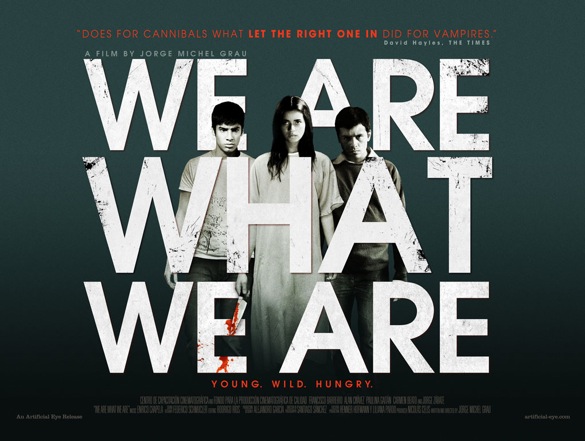


Another IndieFest film with U.S. distribution whose theatrical release seems unlikely is Jorge Michel Grau's Mexican cannibal movie, We Are What We Are. IFC Films will be releasing it on VOD February 18, but none of our likely local exhibitors (Landmark Theaters, the Roxie, YBCA) are listing it on their upcoming calendars. In this combo of domestic drama, social commentary and full-on horror film, a family of Mexico City cannibals struggles to survive when its patriarch dies and stops bringing home the "bacon." After premiering at last year's Guadalajara Film Festival, the film made stops at Cannes (screening in Directors Fortnight) and Toronto, eventually landing a slot at the ultra-selective New York Film Festival (where MUBI's David Hudson collected these reviews). Also screening at IndieFest from IFC Films is Heartbeats, Canadian whiz kid Xavier Dolan's follow-up to 2009's multiple prize-winning I Killed My Mother. Dolan once again directs himself, this time as a guy competing with his female best friend for the attentions of a dim Adonis. Heartbeats appeared at last autumn's Mill Valley Film Festival and is scheduled for a Landmark Theater release on March 18. Reviews have been mixed, but given that I Killed My Mother was one of my 10 favorite films of 2010 (it had a single screening at Frameline), I have no intention of missing it.


IndieFest has always had a soft spot for exploitation films and I was thrilled to find that they'd programmed Machete Maidens Unleashed!, a movie I've been salivating over since learning of its existence during the Toronto Int'l Film Festival. This documentary about made-in-the-Philippines exploitation films of the 1970's and 80's comes courtesy of Mark Hartley, the same guy who gave us 2008's rollicking Not Quite Hollywood: The Wild, Untold Story of Ozploitation! I'm a sucker for that era's jungle-set women's prison movies like Black Mama, White Mama and The Big Bird Cage, and judging from the trailer, it looks like I'll be getting my fill of clips and wild production tales from the likes of Roger Corman, Jack Hill and fave character actor Sid Haig. In a tip of the hat to neo-exploitation, IndieFest will also be showing the fabulously awful-looking Nude Nuns with Big Guns from director Joseph Guzman (Run! Bitch Run!). Asun Ortega stars a Sister Sarah, a nun who extracts bloody revenge on the motorcycle gang who kidnapped and held her in drug-addled, sex-slave captivity. It takes a stronger man than I to resist a film with the taglines "Hell hath no fury like a nude nun with a big gun" and "This Sister is One Bad Mother."


For the second year in a row, the IndieFest folks will be running a SF Winter MusicFest in conjunction with the film festival, with over 40 bands performing live at CELLspace. I'll leave it for the young'uns to savor the song stylings of groups like Shit Outta Luck, Nihilist Cunt and Sistas in the Pit. Meanwhile, IndieFest will be featuring seven new music documentaries, two of which I've previewed and strongly recommend. Pascal Forneri's Gainsbourg, the Man Who Loved Women is a 2010 made-for-French-TV doc that's a perfect companion piece to last year's phantasmagorical biopic – and my top film of the year –
Gainsbourg (vie héroique). The focus here is on the provocative singer/songwriter/superstar's relationships with the women in his life, both musical and personal – or as often as not, some combination of the two. Interestingly, the director skipped the talking heads approach to bio-doc filmmaking and has constructed his film entirely of archival footage. Voiceover commentary is layered over these materials by all the pertinent players, including wife and daughter Jane Birkin and Charlotte Gainsbourg, Brigitte Bardot, France Gall, Françoise Hardy, Juliette Gréco and Vanessa Paradis. And oh what archival materials! As someone who's spent days trolling YouTube for clips of Gainsbourg and his pop music progeny, I can attest that much of what's in this film in super-rare. My only complaint is that none of Gainsbourg's brilliant lyrics are subtitled in English. This is understandable given that his penchant for poetic, intricate wordplay would have made this too massive an undertaking for a film that will certainly never see US/UK theatrical or DVD release.


Another terrific documentary, especially for armchair ethno-musicologists, is Dominique Margot's Toumast: Between Guitars and Kalashnikovs. Toumast means "identity" in the language of the nomadic Tuareg tribespeople who've inhabited the Sahara Desert for millennia. The film focuses on their struggle for autonomy in the post-colonial era, and how it's evolved into a musical liberation movement. At the center is Moussa Ag Keyna, former freedom fighter and now guitarist and lead vocalist for the group Toumast. He shares the film's musical spotlight with Tilwat, an energetic collective of marginalized female musicians and vocalists from Mali, a country that has been especially ruthless – along with Nigeria – in its oppression of the Tuareg people.


The only other film I've seen in this year's IndieFest line-up is Jeanne Labrune's Special Treatment, which I caught at the Palm Springs International Film Festival a few weeks ago. Isabelle Huppert stars as a high class prostitute who specializes in staging elaborate fantasies for her customers. She's also looking to get out of the business and has a taste for pricey antiques. Sharing that passion for objects d'art is Bouli Lanners (Eldorado), a miserable shrink who hopes that a call girl assignation will cure his contentious marriage. For its first hour, Special Treatment zips along as a slick, snarky satire that lampoons both psychiatry and prostitution. Unfortunately, it descends into a maudlinness that's laughably ingenuine, based on all that has preceded it. Still, the film is a must-see for Huppert fans, and not just for the outlandish costumes she gets to wear (my favorite being the 1950's housewife drag, replete with curlers, polka-dot "Lucy" dress and a lap full of crocheting).


I've only covered 10 of the 35 features and none of the five shorts programs being screened this year, so be sure and check out the rest of what's on offer. Some interesting possibilities might include a documentary about a Petaluma Ugliest Dog contest (Worst in Show), a doc about the founder of Est (Transformation: The Life & Legacy of Werner Erhard) and a film created entirely from imagery lifted off the video game Grand Theft Auto IV (The Trashmaster). IndieFest has also become legendary for its parties, which this year includes the 8th Annual Big Lebowski Party, Superbowl XLV: Men in Tights, a Roller Disco Wrap Party and February 14th's Love Bites: Power Ballad Sing-a-long, which is IndieFest's very own anti-Valentine's Day event. Finally, for those who go to film festivals to watch "film," I've been informed that the following movies will be shown in 35mm, with everything else being digital: Kaboom, Fuerteventura, Special Treatment, Heartbeats and We Are What We Are.


Cross-published at The Evening Class and Twitch.

Monday, January 3, 2011

Favorite Films of 2010


As always, I held off posting my year-end lists until all 365 days ran their course – inclined as I am to watch stuff right up to the stroke of midnight on December 31. That said, my final lists didn't change one iota from drafts I made three weeks ago. I managed to watch around 300 "new" narrative and documentary features in 2010, kicking the year off with The Imaginarium of Doctor Parnassus and finishing it up with some True Grit.


2010 Ten Favorite Narrative Features
1. Gainsbourg (Vie héroique) (France, dir. Johan Sfar)
2. The Milk of Sorrow (Peru, dir. Claudia Llosa)
3. Mother (South Korea, dir. Bong Joon-ho)
4. Black Swan (USA, dir. Darren Aronofsky)
5. Dogtooth (Greece, dir. Giorgos Lanthimos)
6. I Killed My Mother (Canada, dir. Xavier Dolan)
7. The Social Network (USA, dir. David Fincher)
8. About Elly (Iran, dir. Asghar Farhadi)
9. Domain (France/Austria, dir. Patric Chiha)
10. La Pivellina (Italy/Austria dir. Tizza Covi, Rainer Frimmel)


Out of the 230 narrative features I saw, roughly 25% were viewed at home via DVD screeners, cable-VOD or on-line streaming, and the rest I watched in theaters. As I sat reveling in
Gainsbourg at last spring's SF International Film Festival (where it was shown under the title Gainsbourg (Je t'aime, moi non plus), I knew I had my top movie of the year. In his filmmaking debut, graphic novelist Johan Sfar took key moments from Serge Gainsbourg's life and career, and turned them into richly-conceived mythical fantasias. Eric Elmosino delivers an astounding lead performance, aided by brilliant supporting turns by actresses portraying the women in his life (particularly Laetitia Casta and Anna Mouglalis as Brigitte Bardot and Juliette Gréco). While my obsession for the man's music may have colored my appreciation for a film many disliked, at least Neue Zürcher Zeitung agrees with my assessment. It's unlikely this film will have a U.S. theatrical release or English-subtitled DVD for that matter, so I'm thrilled to be seeing it again next week at the Palm Springs International Film Festival.


And speaking of the Palm Springs festival, that's where I first encountered five of the films on this list – all highlights of 2009's Berlin and Cannes film festivals. They were so terrific, I'd see four of them again when they later came to the Bay Area. Mother had a surprising six-week run at various local Landmark Theaters, while About Elly showed up at the SF International Asian American Film Festival. Dogtooth, which was simultaneously the funniest and most disturbing film I'd see all year, had one showing (in abysmal digital) at the Greek Film Festival and a later one-week run (in 35mm) at the SF Film Society's Kabuki Screen. I Killed My Mother entertained a packed Castro Theater one Saturday night during Frameline. Only the spellbinding The Milk of Sorrow never made it to these parts, despite an Oscar® nomination for Best Foreign Language Film and the top prize at 2009's Berlin Film Festival.


Slots nine and 10 of my list could have been filled by any one of two dozen contenders. I picked
Domain, which stars Béatrice Dalle as a scary alcoholic mathematician, after noting that John Waters had named it his #1 film of the year. Mr. Waters and I both saw it at the SF International Film Festival. You can see it, too, by spending three bucks at MUBI. Also at this year's SFIFF was La Pivellina, an endearing nod to neo-realism centering on a family of Italian circus performers. Rounding out the list are my two favorite American films of the year, Black Swan and The Social Network.


The Best of the Rest
127 Hours (my fave Danny Boyle film since Trainspotting, for which James Franco deserves an Oscar®), Alamar, All About Evil (we love you, Peaches), Animal Kingdom, Carlos, Chloe (minus the crackpot ending), City of Life and Death, the first half hour of Coco Chanel & Igor Stravinsky, Cyrus, Everyone Else (simply flawless), Father of My Children (especially the first half), Inception, Kinatay (Mr. Ebert, you embarrass yourself by calling this the worst film shown in the history of the Cannes Film Festival), The King's Speech, Leo's Room, Love Like Poison, Plan B, Please Give (the first Nicole Holofcener film to wow me), Police, Adjective (the dictionary scene!), The Robber, The Silence, Toy Story 3 and The White Meadows (let's not forget that Mohammad Rasoulof was convicted along with Jafar Panahi).


2010 Ten Favorite Documentary Features
1. Henri-Georges Clouzot's Inferno (France, dir. Serge Bromberg, Ruxandra Medrea)
2. Marwencol (USA, dir. Jeff Malmberg)
3. Agrarian Utopia (Thailand, dir. Uruphong Raksasad)
4. Inside Job (USA, dir. Charles Ferguson)
5. Beautiful Darling (USA, dir. James Rasin)
6. Dzi Croquettes (Brazil, dir. Raphael Alvarez, Tatiana Issa)
7. 14-18: The Noise and the Fury (France, dir. Jean-François Delassus)
8. My Perestroika (USA/UK/Russia, dir. Robin Hessman)
9. The Topp Twins: Untouchable Girls (New Zealand, dir. Leanne Pooley)
10. Most Valuable Players (USA, dir. Matthew D. Kallis)


I watched nearly 70 documentary features in 2010 – 25% of them in theaters and the remainder at home on DVD screeners or on-line streaming – the inverse ratio of my narrative feature viewing. The doc that should be at the top of this list is David Weissman's devastating We Were Here: Voices from the AIDS Years in San Francisco. I left it off because the showing at Frameline was a sneak preview screening. The film will have its official world premiere at Sundance this month, and then immediately proceed to the Berlin Film Festival.


Friday, December 31, 2010

2010 Favorite Bay Area Repertory/Revival Screenings


The Bay Area continues to be an incredible place to experience repertory cinema. There are few places on the planet where it's possible to see a film every day of the year and not watch a single new release. In 2010 I caught 47 revival screenings at various local venues. Here, in no particular order, are 10 of the most memorable.


Showgirls (Castro Theater)
What better way to celebrate the 15th anniversary of my fave film of the 1990s. Peaches Christ brought an expanded version of her infamous Showgirls Midnight Mass preshow to a sold-out Castro, complete with exploding on-stage volcano and free lapdances with every large popcorn. It inspired me to inaugurate my iphone's movie camera feature and create a YouTube channel to post the results. Apart from Peaches' Castro world premiere of All About Evil, this was the most fun I had at the movies in 2010.


Armored Car Robbery (Castro Theater, Noir City)
I was blown away by this taut and tidy 67-minute slice of obscure 1950 B-Noir about the aftermath of yes, an armored car robbery outside L.A.'s Wrigley Field. It would be brought back to mind months later with the Fenway Park heist of Ben Affleck's The Town. Other 2010 Noir City highlights included the double bill of Suspense (1946) and The Gangster (1948), both starring British ice-skating queen Belita, and 1945's San Francisco-set Escape in the Fog, which begins with a woman dreaming about an attempted murder on the Golden Gate Bridge.


Pornography in Denmark (Oddball Cinema)
There's something weird and wonderful going on each weekend at Oddball Cinema, a funky alternative film venue tucked inside the Mission District warehouse digs of Oddball Film + Video. In the spring they screened a 16mm print of this landmark 1970 documentary by local porn-meister Alex de Renzy, which became the first hardcore to show in legit U.S. theaters and be reviewed in the NY Times. Introducing the film was writer/film scholar Jack Stevenson, who was on tour promoting his book, "Scandinavian Blue: The Erotic Cinema of Sweden and Denmark in the 1960s and 1970s."


Freddie Mercury, the Untold Story (VIZ Cinema, 3rd i's Queer Eye Mini-Film Festival)
3rd i is best known for the SF International South Asian Film Festival it puts on each November. Back in June they packed SF's snazzy subterranean VIZ Cinema with this revival of Rudi Dolezal and Hannes Rossacher's 2000 documentary – seen in a new director's cut with 43 extra minutes. The audience went nutso at the climax of "Barcelona," Mercury's soaring duet with Montserrat Caballé from the 1986 summer Olympics. Further repertory kudos to 3rd i for bringing an exquisite 35mm print of 1958 Bollywood classic, Madhumati, to the Castro.


Mädchen in Uniform (Castro Theater, Frameline)
A whole lot of LGBT folk must've played hooky from work to catch this mid-day, mid-week revival from 1958 – itself a remake of a 1931 queer cinema classic. Romy Schneider and Lili Palmer are respectively radiant as a student obsessively in love with her boarding school teacher – to the extreme consternation of battleaxe headmistress Therese Giehse. Shown in a gorgeous and rare 35mm print, with the inimitable Jenni Olson delivering a dishy intro. Frameline34's other revelatory revival was Warhol's 1965 Vinyl, in which Factory beauties Gerard Malanga and Edie Sedgwick dance a furious frug to Martha and the Vandellas "Nowhere to Hide." Twice.


The Aztec Mummy vs. The Human Robot (Pacific Film Archive, "El Futuro Está Aquí: Sci-Fi Classics from Mexico")
If anything's capable of luring me out of the city on a Saturday night during Frameline, it's bunch of Mexican monster movies from the 50's and 60's. This was double-billed with Santo vs. The Martian Invasion, which had a little too much rasslin' for my tastes. But it boasted a hilarious opening scene in which the Martians explain why they happen to be speaking Spanish. It killed me to miss Planet of the Female Invaders and The Ship of Monsters, also part of this series.


Metropolis (Castro Theater, SF Silent Film Festival)
"When you've waited 83 years, what's another 40 minutes?" Eddie Muller quipped to the antsy, capacity crowd awaiting the Bay Area premiere of Fritz Lang's finally-complete expressionist dystopian masterpiece. In spite of the late start time and disappointing digital format, this was still the repertory event of the year. The Alloy Orchestra performed its celebrated score live and Muller conducted an on-stage conversation with Paula Félix-Didier and Fernando Peña, the Argentine film archivists who discovered the 16mm print of Metropolis with 25 additional minutes. The Alloy Orchestra would return to the fest two days later to perform their heart-stopping score to Dziga Vertov's Man with a Movie Camera.


The Cook/Pass the Gravy/Big Business (Castro Theater, SF Silent Film Festival)
Each year this festival invites a filmmaker to program a Director's Pick – and past pickers have included the likes of Guy Maddin and Terry Zwigoff. This year Pete Docter (Monsters, Inc., Up) assembled a program of three comic shorts titled The Big Business of Short Funny Films, each of them screamingly funny. First, Fatty Arbuckle and Buster Keaton had a go at each other in The Cook, followed by some hysterical nonsense involving feuding families and a prized rooster in Pass the Gravy. Finally in Big Business, door-to-door Christmas tree salesmen Laurel and Hardy declared war on a disgruntled customer, taking tit-for-tat to absurd heights.


The Boston Strangler (Pacific Film Archive, "Criminal Minds")
This ranks as my personal discovery of the year. Director Richard Fleischer employs a wry tone and magnificent use of wide and split screen to tell the story of 60's serial killer Albert DeSalvo. A restrained Tony Curtis, whose title character doesn't appear until the midway point, gives what must surely be the best dramatic performance of his career. Oscar ® didn't care. With Henry Fonda, George Kennedy and an early appearance by Sally Kellerman as the one girl who got away. Double-billed with 1944's The Lodger, a compelling Jack the Ripper yarn starring Merle Oberon, George Sanders and Laird Cregar.


Johanna (Roxie Theater)
I was woefully resigned to never seeing Kornél Mundruczó's 2005 filmic opera about a junkie performing sex miracles in a subterranean Budapest hospital, which had never screened in the Bay Area or been released on Region 1 DVD. Then the Roxie answered my prayers by showing a gorgeous 35mm print for two nights in November, double-billed with the director's follow-up, 2008's Delta. Earlier in the month, the Roxie revived 36 Quai des Orfèvres, a gritty and stylish 2004 policier that had also inexplicably gone unseen the Bay Area, despite starring Gérard Depardieu and Daniel Auteuil.


Honorable Mentions

Traffic (1971, dir. Jacques Tati, Yerba Buena Center for the Arts)
Insiang (1976, dir. Lino Brocka, Sundance Kabuki, SF International Asian American Film Festival)
Black Narcissus (1947, dir. Michael Powell & Emeric Pressburger, Pacific Film Archive, "Life, Death and Technicolor: A Tribute to Jack Cardiff")
Hausu (1977, dir. Nobuhiko Ôbayashi, Castro Theater)
A Night to Dismember (1983, dir. Doris Wishman, Yerba Buena Center for the Arts, "Go to Hell for the Holidays: Horror in December")

Tuesday, December 21, 2010

Bay Area 2010 Fall Festivals – A Look Back


"My wife and I are now enjoying films at the Arab Film Festival. Then we will see films at the French and Italian film festivals and then finish off with a film at Berlin & Beyond. At the same time, there was the Mill Valley Film Festival and the Taiwan Film Festival. And I have probably missed a festival or two this fall season. Some of these film festivals overlap. Sometimes too much of a good thing can be too much for us poor movie buffs. I suggest that the various film festival directors have a summit and divide up the year so festivals don't overlap or get too crammed together. I suspect attendance would improve and we filmgoers won't get so overwhelmed. Just a thought."

Ralph E. Stone, San Francisco


The above letter appeared in the October 22 San Francisco Chronicle and enjoyed wide circulation among Bay Area cinephiles. It gave voice to our frustrated sense of being in-fest-ed, as Hell on Frisco Bay's Brian Darr would put it, by more movie choices than ever this autumn. Yes, Mr. Stone, you did miss "a festival or two," or even twenty. I was festival-ing nearly every weekend, yet here are some I missed: Iranian Film Festival, Irish Film Festival, Bicycle Film Festival, International Children's Film Festival, Taiwan Film Days, Cinema by the Bay, Chinese American Film Festival, United Nations Film Festival, American Indian Film Festival, Buddhist Film Festival and Tranny Fest. And for the first time this year, my participation in the Mill Valley Film Festival and SF DocFest was necessarily limited to watching DVD screeners.

Having too many choices beats having too few, but like Mr. Stone, I'm certain it would benefit both audiences and festivals alike if the wealth were spread around. While we're holding our breath waiting for that summit to happen, here's my first-day-of-winter report on the seven Bay Area fall film fests I was able to partake in.


SF Latino Film Festival (Sept. 16 – 26)
November 2009 witnessed a resurrection of the Latino Film Festival by the organization Cine + Mas. It was woefully under-attended, a result of being scheduled smack in the middle of a fest-saturated November. This year they shifted to September, making theirs the first major fall fest out of the gate. And a change of venue to the Mission
District's Roxie Theater brought it all closer to their core audience. This seemed to do the trick. Opening night witnessed a large, enthusiastic crowd and I heard reports of healthy ticket sales for the rest of opening weekend, including a near sell-out for Mexico's multiple Ariel-nominated Heart of Time.

Opening Night's double bill was a winner. First up was
La Yuma, Nicaragua's first feature film in 20 years and its submission for this year's Best Foreign Language Film Oscar®. More crowd-pleaser than art film, it boasts a powerhouse debut by Alma Blanco as a woman determined to literally box her way out of a Managua slum. While the story is preposterously overloaded – the titular La Yuma has a gangleader boyfriend, a thieving brother, a sister who's being molested by her mother's boyfriend, a prickly romance with a middle-class university student, a tranny best friend and a boxing trainer who moonlights as a male stripper – it's all served up with vigor and humor. The Roxie audience howled each time Blanco let loose with an obscene tirade, making me regret my lack of fluency in Central American insults. Humor, albeit of a gentler nature, was also in evidence in the evening's co-feature. Leo's Room proved an intelligent, wry look at one Uruguayan university student's struggle with stasis and sexual identity.


Arab Film Festival (Oct. 14 – 24)
Although I wasn't planning on it, at the last minute I found myself available to attend AFF's opening night at the Castro Theater. After welcoming everyone to the 14th edition of the largest and oldest fest of its kind in North America, the evening's hosts got down to handing out the annual Noor Awards (noor being the Arabic word for light). Outstanding Feature Film went to Syria's
Once Again, which surprised me in light of its spare, two-sentence description in the festival catalog. Feature Film Honorable Mention would go to Morocco's The Man Who Sold the World, with its fraternal directing duo, Imad and Swel Noury taking a bow from the audience. (Happily, they would remain in town for their film's screening eight days later). Outstanding Documentary was given to 12 Angry Lebanese. Following the awards, the crowd took delight in the Opening Night film Mascarades, a heartfelt social comedy set in a remote Algerian village. The film's engaging director and star, Lyès Salem, was on hand at the Castro. In the Q&A he revealed that this decidedly feminist film was a tribute to the women who held Algeria together during the 1990s civil war.

I would catch two additional AFF screenings, both of them marred by late start times and 35mm projection snafus. But at least I got to see them on film. Apparently, some film prints were held up in customs, which forced the festival to project watermarked DVD screeners. According to my spies, in at least one case the audience was never advised of the substitution. And as long as I'm complaining, I'll mention that the Arab Film Festival wins the prize for having the most audience members who text and email during movies. Alas, the films themselves were a worthy pair. While Yousry Nasrallah's feminist Egyptian melodrama
Scheherazade, Tell Me a Story turned out to be a bit of a head-scratcher, it's a film I'd been dying to see and I'm grateful to the festival for programming it. I was more taken by the Noury brothers' The Man Who Sold the World, a Dostoevsky-based dystopian allegory that featured an intriguing sound design, glorious widescreen compositions and a lively post-Q&A.


Berlin & Beyond (Oct. 22 – 28)
The Bay Area's festival of German-language film went into its 15th edition with two strikes. First, there was resentment over the move from January into an October already overstuffed with festivals. More important was the acrimony people still felt over the Goethe-Institut's unceremonious ousting of B&B founder Ingrid Eggers. While there was some talk of a boycott, film festival sluts like myself found it impossible to forego certain must-see titles. At any rate, attendance was down compared to years past. Newly appointed Festival Director Sophoan Sorn, a Cambodian-born young man who founded the San Joaquin International Film Festival, proved himself a genial and
effusively enthusiastic host. As for Eggers, she's expanding her new German Gems festival, which debuted last February as one-day event. It returns as a three-day mini-fest that'll happen in B&B's original January slot – at the Castro, of course. Competing German film festivals can now be added to that list of things "only in San Francisco."

I only caught three films at this new B&B, starting with Centerpiece Film
When We Leave, directed by Feo Aladag. It's Germany's 2010 Oscar® submission and was met with rapturous applause as the credits rolled. It was also the only film from all of these autumn festivals I truly hated. What can I say? What I perceived as a cheesy melodrama in which a sympathetic protagonist does endlessly idiotic things in order to advance a filmmaker's agenda, others evidently perceived as a noble and tragic social issue drama – that issue being Muslim honor killings. Fortunately, my other two B&B choices were first rate. I knew I needed to see Benjamin Heisenberg's The Robber after it was chosen for the ultra-picky New York Film Festival. This hypnotic, observational narrative about one man's obsession with marathon running and bank robbing made good on the promise of Heisenberg's debut Sleeper, which screened at B&B in 2006. The film has been picked up for U.S. release and Michael Guillén conducted a revelatory interview with Heisenberg during the festival (as well as posting this concise overview of the B&B line-up). Equally terrific was Baran bo Odar's The Silence, a visually stunning, character-driven police procedural whose 9 p.m. mid-week screening was criminally under-attended. The 35mm print promised in the B&B catalog was replaced by digital and not announced as such.


French Cinema Now (Oct. 28 – Nov. 3)
One reason for the Bay Area's autumn festival congestion is the SF Film Society's ever-expanding "Fall Season," which consisted of six festivals and five special events this year. For the first time, I heard a bit of SFFS-aimed grousing from audience members and competing festival staff-members alike. All I know is that by the time French Cinema Now rolled around, I was ready to put myself in the hands of professionals who know how to properly run a cinema event. Their screenings begin
exactly on time, in the format promised, are knowledgably introduced and preceded by an announcement to shut off cell phones and keep them off. (film-415 kudos to programmer Rod Armstrong for his vigilance in this regard.)

Since I saw nine of the 10 films on offer, there's only time here for some general thoughts. For starters, the Bay Area loves those iconic French actresses. Five FCN screenings were sellouts – two showings each of Isabelle Huppert's
Copacabana and Juliette Binoche's Certified Copy, plus a screening of Catherine Deneuve's Hidden Diary. Marc Fitoussi's light-hearted dramedy Copacabana was an ideal fest opener, with Huppert as a middle-aged hippie chick selling vacation timeshares. I felt absolutely giddy watching her in a film where she wasn't poisoning her family or performing abortions or sniffing tissues picked off the floor of a porno video arcade. (After the screening, director Fitousi would have the pleasure of announcing the Giants' win in Game 2 of the World Series.) The malevolence missing from Huppert's role manifested itself in Deneuve's heartless, mean-mouthed mother of Hidden Diary. Her performance was delivered with a vituperative gusto that triggered waves of audience sniggering. Perhaps it's high time for Deneuve to follow Joan and Bette into the land of battleaxed bogeywomen? A remake of William Castle's Straight Jacket, peut-être? Have a look at the poster and tell me you can't picture Catherine wielding that hatchet.

My favorite FCN film turned out to be one that hadn't been on my radar. Katell Quillévéré's intimate
Love Like Poison featured a memorable debut performance by Clara Augarde as a teen grappling with issues of flesh vs. spirit in small town Bretagne. The final, bittersweet film appearance of Guillaume Depardieu was a highlight of Sarah Leonor's distinguished A Real Life. Lucas Belvaux brought his taut, corporate kidnapping thriller Rapt to Opening Night, and the stimulating Q&A went well past midnight. I also enjoyed Two in the Wave, Emmanuel Laurent's documentary about François Truffaut and Jean-Luc Godard which will have a run at the Roxie Theater early next year. For a nice change of pace there was Bertrand Tavernier's 16th century historical romance, The Princess of Montpensier. I appreciated it mostly for the performances of three favorite French actors: Lambert Wilson, Gregoire Leprince-Ringuet and Gaspard Ulliel. FCN closed with Abbas Kiarostami's Certified Copy, a film I was closely in tune with until its mid-film, enigmatic conceit turned tiresome.


3rd i South Asian Film Festival (Nov. 3 – 7)
While I experienced most of this year's 3rd i via DVD screeners, I did come out for three programs. Occupying Saturday night's traditional "Bollywood at the Castro" slot was Punit Malhotra's
I Hate Luv Storys, an affectionate satire of romantic Bollywood tropes that didn't inspire me to stay past the interval. Besides, I needed to be back at the Castro for Sunday morning's highly anticipated 35mm revival of Bimal Roy's 1958 classic, Madhumati. Apart from some scratches in the first reel, this otherwise flawless print looked exquisite on the huge Castro screen. There were some vexing technical difficulties projecting digital subtitles over the 35mm image, but it hardly mattered given Madhumati's easy-to-follow storyline. This was a rare treat, rendered more so by the amusing anecdotes recounted by Manoj Shailendra (the son of renowned Bollywood lyricist Shailendra), who was on hand to introduce the screening.

I returned later that evening for the closing night film, Dev Benegal's
Road, Movie. This tale of a taciturn young man driving a mobile cinema across the Rajasthan desert was a bit clunky, but was redeemed by spectacular desert photography and a contemporary consciousness surrounding water issues. As always, 3rd i's closing party in the Castro mezzanine was a blast. It was there I learned something interesting about director "Q"s groundbreaking, XXX-rated Gandu. It seems that the version screened during the festival was a radical re-edit from the one I watched on screener – and by several accounts, something approaching a masterpiece. Hopefully, 3rd i will bring it back sometime next year (and screen it earlier than midnight).


San Francisco International Animation Festival (Nov. 11 – 14)
I wasn't expecting to see anything in this festival given the lack of a big-buzz feature like
Waltz with Bashir or Fantastic Mr. Fox in the line-up. You see, I'm not much of an animation enthusiast, with Toy Story III being the only such film I saw in 2010. I'm also not particularly keen on shorts programs. But when I saw that a favorite Bay Area writer had co-curated a program of animated shorts, I snapped up a ticket. SF Bay Guardian Arts and Entertainment Editor Johnny Ray Huston – who unfortunately rarely writes about film these days – put together Channel Drift in cahoots with local video artist/animator Skye Thorstensen. Their fabulously eclectic selection ranged from recent Tostitos commercials to classic works like Suzan Pitt's awesomely trippy Asparagus. A personal favorite was Paul Vester's Abductees, which refashions the drawings and hypnotic regression tapes of alleged space alien abductees into something humorously affecting. In all, this was one of the best times I had at the movies this fall, and I thank the SF Film Society for inspiring me to experience something different.


New Italian Cinema (Nov. 14 – 21)
I was disappointed when I first looked at this year's N.I.C.E. line-up, as the two new Italian films I'd hoped for were M.I.A. (For the record, they're Michelangelo Frammartino's
The Four Times, probably the most lauded Italian film on the 2010 fest circuit, and Pietro Marcello's The Mouth of the Wolf, a docu-fiction hybrid that won the Berlin Film Festival's Teddy Award for Best Documentary and was a curious omission from this year's Frameline.) Furthermore, a full third of the N.I.C.E. line-up was given over to the films of Ferzan Ozpetek, with the director in attendance. I'd always felt indifferent towards Ozpetek's work until I saw 2007's risible melodrama Saturn in Opposition, which put me off wanting to see his two latest films, A Perfect Day and Loose Cannons. (N.I.C.E. also presented retrospective screenings of Steam: The Turkish Bath and Facing Windows).

After a bit of research, I managed to find four films that sounded promising. If not for its absurd denouement, Alessandro Angelini's
Raise Your Head might have been one of my Top Ten films of the year. Serge Castellitto gives a career-high performance as a working class shipbuilder who learns that the heart of his deceased son has been transplanted into the body of a Slovenian transsexual. Almost its equal was The Double Hour, the feature debut of fashion photographer and music video director Giuseppe Capotondi. This highly stylized combo of romance/thriller/caper film occasionally approached the brink of ludicrousness, but never quite crossed that line. While Ksenia Rappoport won the Venice Film Festival's Best Actress prize for her role as a double-crossing hotel maid, it was heartthrob Filippo Timi (Vincere's Mussolini) who commanded my attention as the brooding security guard she victimizes. Valerio Mieli's worthy, well-acted Ten Winters followed the rocky, thwarted romance of two Venetian students over the course of 10 years. Six or seven winters would have been plenty for me.

Finally, N.I.C.E. closed with
The First Beautiful Thing, Italy's 2010 Oscar® submission and the latest from Paolo Virzi (whom N.I.C.E. feted in 2008). This nostalgic, flashback laden dramedy tells the story of a sad sack, substance-abusing professor who's dragged back into the life of his ebullient mother (Stefania Sandrelli), now dying of cancer. Shrill and broad, but not entirely unwatchable, it was hard to believe this came from the same director as such comparatively distinguished films as Ovosodo and Caterina in the Big City. On Closing Night, Edoardo Leo's 18 Years Later was given the audience-bestowed City of Florence Award for best film. I missed seeing it at N.I.C.E., but will have an opportunity at next month's Palm Springs International Film Festival, where it's just been announced as part of the 2011 line-up.